The Facilitator's Playbook
The whole method. Free.
112 pages. Every mistake included.
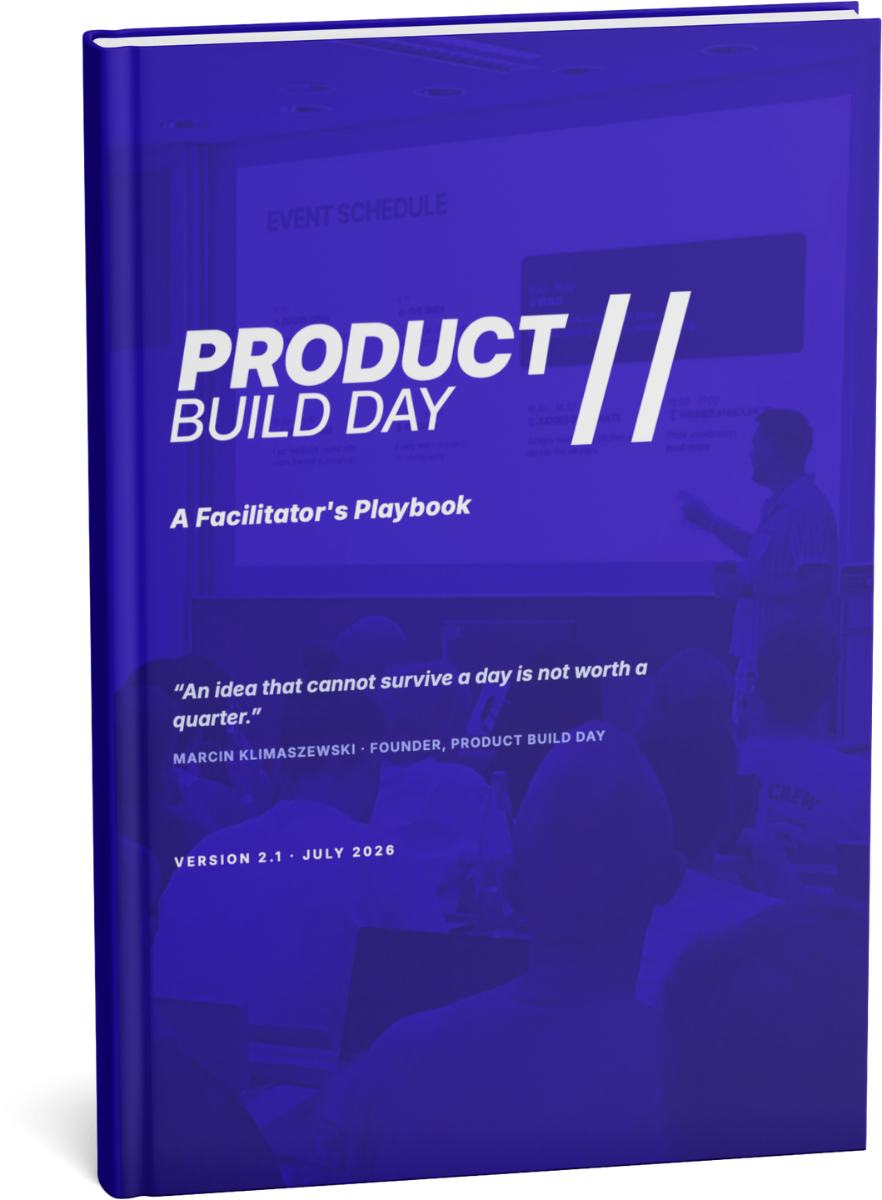
Read it online
Seven chapters. 83 pages.
01
Introduction
Why now, the manifesto, and where this method sits next to design sprints and LDJs (with respect).
Read →02
Before the day
Getting the yes, filling the seats, the sponsor, test users, and the deepest part of the book: defining the challenge.
Read →03
The day
The ugly prompt, two AIs are better than one, the three hats, note-and-vote, and what the facilitator does for six hours.
Read →04
After the day
The week after, when it wobbles, and running it again.
Read →05
The handouts
Seven printable cards for the room, from the brief card to the judge's scorecard.
Read →06
The templates
Five ready texts: invite, sponsor briefing, test user ask, decision one-pager, wrap-up post.
Read →07
FAQ, sources, licence
Every question, every source, and the Creative Commons terms.
Read →Challenging, exciting, interesting, educational. I liked that in the legal track, there was a real industry practitioner who had first hand experience with user problems we tried to solve.
Kamila Kołaczkowska
The templates, ready to steal
A good brief defines the user, their context, and their goal, then stops. Nothing about the solution; the solution belongs to the teams. The one I wrote for Ionian Technologies, 31 words:
"How might we help a returning 25-year-old Zara shopper open the app at 7:45 a.m. and choose a complete outfit from her saved looks and today's feed in under 90 seconds?"
- • The user is a person you can picture and recruit, not a segment
- • The timestamp sets constraints no feature list could
- • The 90 seconds is a finish line a judge can check with a stopwatch
- • No screen or feature named, so four teams can serve it four different ways
Write yours in that shape, aim for around 31 words, then test it on one person and watch their face.
It became clear to me that spinning up several working MVPs of the same idea — each implemented differently, with a different preset of features and design — is a genuinely fast task, and one that helps you figure out much earlier, right at the brainstorming stage, what actually belongs in the final version. I'm definitely adding this to my toolkit.

Yevhenii Harychev
Articles
- What is a Product Build Day? →
- How a Product Build Day runs, step by step →
- How to define a good challenge →
- How to run the build hours →
- How to test a business idea before you build it →
- How to test a business idea after you build it →
- Prototypes instead of PRDs, user stories and epics →
- Where to actually learn AI-era product skills →
Used the playbook? Tell me.
Run a day from this book and write to me: what worked, what broke at 11:40, what your room decided. Every version of this playbook got better because a facilitator somewhere was honest with me. You ran it, you get the credit, and version 2.2 gets your fix.
Open the contact form →The teams build the prototypes. You build the room.
112 pages, zero euros, one email.